
Are You Paying Too Much for Your Bookings?
Are you paying too much for your bookings? All guests come at a cost, but that cost can vary greatly. Determining the breakdown of what you are paying for your bookings is a key component in operating a sound lodging business and generating a reasonable profit.
Understanding the profit picture
Before digging into the cost of your bookings, let’s look at the full financial picture. Profit is a function of revenue less cost. Revenue for a lodging business is a combination of volume (rooms), price (ADR), and occupancy to generate room revenue, plus any non-room revenue. Costs, on the other hand, are generally categorized as variable and fixed.
Variable costs fluctuate with the number of guests and include items like sales costs (commissions) and supplies. Fixed costs are not affected by occupancy and account for expenses like property taxes, mortgage, and insurance. Some expenses have both a variable and fixed component, like labor costs, and maybe fixed in the short term but gradually more variable in the long term.
It is important for a lodging business to separate variable and fixed costs to know what its variable contribution margin (VCM) is on a per room basis. The VCM is essentially the profit margin per room after subtracting variable costs, but before factoring in any fixed costs. A property will lose money in the short term if it rents a room for less than its variable costs. In the medium term, one must also factor in costs that are fixed in the short term but maybe variable over time, like labor costs. In other words, your VCM level is typically unchangeable in the short term but can be altered over time. Of course, in the long term, a property must cover both its variable and fixed costs if it is to be financially self-sustaining. The table illustrates a hypothetical profit picture of “The Independent Lodging Company” through the Income Statement/Profit and Loss Statement (P&L).
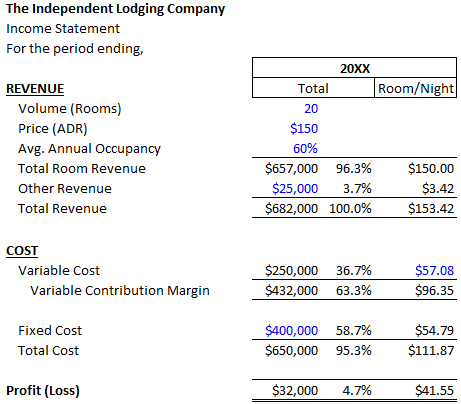
Since every property is different, the nuances of variable and fixed costs relative to occupancy over time must be well understood. Knowing your booking costs, recognizing your margins under various scenarios, realizing it is better to lose a little than to lose a lot, and remembering that rooms (like milk) have an expiration date, will aid you in setting discounts, choosing booking channels, and maximizing profits.
Understanding your direct booking cost
A direct booking is what the name implies; a booking that is made directly with your property without any other parties involved. Just you and your guest. Today that booking is typically on your website, but it could also be a phone call or a walk-in. A direct booking may have either fixed cost implications, variable cost implications, or a hybrid of both.
For example, a loyalty discount or a direct referral fee will cost you something every time it results in booking and is typically a variable cost. Online marketing efforts may combine both variable and fixed costs. If you engage an agency to help you manage your account, or have in-house staff, you generally incur a fixed cost in terms of salary or service fee. Pay-per-click (PPC) or email campaigns on your account will have variable components tied to certain activity, even though not directly correlated to your bookings. Whether you engage an agency or have professional people on staff, with practice and analytics tracking you should understand how the cost of your online marketing activity relates to your booking costs.
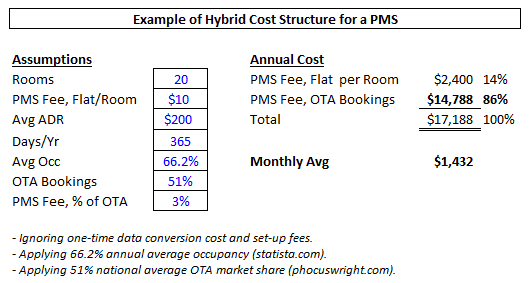
Finally, a truly fixed cost of direct bookings can be the cost of your website or your reservation software, assuming you pay a flat fee for those services. Some providers attach a commission percentage to your bookings or a segment of your bookings, so be careful to read the fine print. In the example to the left, this provider attaches a “small 3% fee” to all bookings originating through their OTA connections. At first, it seems innocuous enough, but at a closer look, you’ll realize it accounts for more than 85% of the total, bringing the cost to $1,432 per month, or more than $70 per room per month. At rezStream we believe in a flat fee service cost, so even at our rezStream Cloud Pro level, the monthly cost would only be $326 for this same property ($13 per room plus a fixed $66 for a channel connection offering over 80 booking sites).
Understanding your third-party booking cost
Third-party bookings come in many variations as well. In the old days, these reservations were typically a brick and mortar travel agency. Today it is likely an online travel agent (OTA) such as Booking.com, Expedia or Hotels.com.
Costs for third-party bookings are almost always variable and can be quite significant, as high as 30% of the value of a reservation in some cases. That cost goes straight to the bottom line for a hotel and eats deeply into the profit margin of the booked room.